
How to Sell Property Abroad: Granting Power of Attorney from California
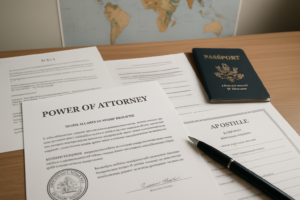
Selling real estate in another country while living in California can feel like navigating a maze of conflicting legal systems, language barriers, and strict government requirements. However, traveling across the world just to sign closing documents is rarely necessary.
By appointing a trusted representative via a Power of Attorney (POA), you can legally authorize a trusted relative, local attorney, or real estate professional to handle the sale on your behalf.
To ensure your California-executed POA is recognized by foreign courts, banks, and land registries, the document must undergo specific authentication steps.
1. Have the POA Drafted by Foreign Legal Experts
A standard California or U.S. template will rarely satisfy foreign property laws.
-
Tailored Authority: Real estate registries abroad often require hyper-specific phrasing authorizing the sale of the exact parcel, setting minimum price thresholds, or specifying bank account details for funds transfer.
-
Bilingual Formatting: Have a legal professional or notary in the target country draft the POA in their official language. If drafted in English, obtain a professional bilingual side-by-side format to avoid processing delays or mandatory foreign translations later.
Key Rule: Always defer to the destination country’s legal requirements for what content must be included inside the POA.
2. Execute and Notarize the Document in California
Once the POA draft is finalized, sign the document in the presence of a commissioned California Notary Public.
Notarization Checklist for California POAs:
-
In-Person Appearance: You must physically appear before the notary and present valid government-issued photo identification.
-
Correct Notarial Wording: California requires specific statutory acknowledgment language (California Civil Code § 1189). Ensure the notary uses an official California acknowledgment block rather than out-of-state or foreign wording.
-
Complete Seal & Signature: The notary’s seal, signature, commission number, and expiration date must be clear and legible.
3. Obtain Legal Authentication (Apostille vs. Embassy Legalization)
A California notary’s seal is only valid within the United States until authenticated for international use. The path you take depends on where your property is located:
Path A: Hague Apostille Countries (Most Common)
If the destination country is a member of the Hague Apostille Convention (e.g., Mexico, Spain, France, the UK, the Philippines), you need a California Apostille.
-
Issuing Authority: The California Secretary of State authenticates the notary’s signature and seal by issuing a single certificate (the apostille) attached to your notarized POA.
-
Filing Options:
-
In-Person (Same-Day): Walk-in counters are available in Sacramento and Los Angeles for rapid processing.
-
By Mail: Send the original notarized document to the Secretary of State’s office in Sacramento.
-
-
Government Fee: $20 per apostille certificate.
Path B: Non-Hague Countries
If the country does not belong to the Hague Convention (e.g., UAE, Vietnam, Qatar), the document must go through a multi-tiered Embassy Legalization process:
-
Notarization by a California Notary Public.
-
Authentication by the California Secretary of State.
-
Authentication by the U.S. Department of State in Washington, D.C.
-
Final legalization at the destination country’s Embassy or Consulate in the U.S.
4. Complete Certified Translations & Foreign Registration
Once the Apostille or Embassy Legalization is attached to your POA:
-
Certified Translation: If your POA was executed only in English, the complete packet—including the California Apostille stamp—must be translated into the destination country’s official language by an accredited foreign translator.
-
Foreign Protocolization: Many civil-law countries require the apostilled POA to be registered or “protocolized” before a local public notary (e.g., Notario Público) before the agent can legally execute the real estate deed.
Summary of the Process
| Step | Action Item | Primary Responsible Party |
| 1. Drafting | Prepare POA following destination country real estate laws | Foreign Attorney / Local Notary |
| 2. Execution | Sign before a California Notary with proper CA acknowledgment | California Notary Public |
| 3. Authentication | Obtain Apostille (Hague) or Consulate Legalization | CA Secretary of State / Consulate |
| 4. Finalization | Translate and register POA in the foreign land registry | Foreign Representative / Agent |
