
What Is Apostille Notary? A Complete U.S. Guide to Apostilles, Notarization, and Certified Translation
What Is Apostille Notary?
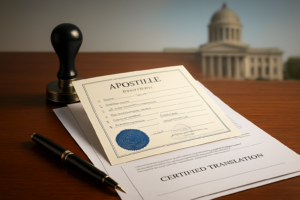
If you have been searching for what is apostille notary, you are probably dealing with documents that must be accepted outside the United States. The phrase is commonly used by people who need international document authentication, but it actually combines two related concepts: notarization and apostille.
A notary is a state-authorized official who verifies identity, witnesses signatures, and helps deter fraud. An apostille is a special certificate issued by a competent government authority that confirms the authenticity of a public document so it can be recognized in another country that is part of the Hague Apostille Convention.
In simple terms, when people ask what is apostille notary, they usually mean: How do I get my document notarized and then authenticated for international use? The answer depends on the type of document, the state where it was issued or notarized, and the country where it will be used.
Understanding the difference matters because not every document needs notarization before an apostille, and not every document qualifies for an apostille in the same way. A professional apostille service can help determine the correct path and reduce the risk of rejection.
What Is an Apostille?
An apostille is an official certificate that verifies the origin of a public document. In the United States, apostilles are generally issued by the Secretary of State for state documents, or by the U.S. Department of State for certain federal documents.
The apostille does not validate the contents of your document. Instead, it confirms that the signature, seal, or stamp on the document is genuine. For example, it may verify that a notary public was properly commissioned at the time of notarization, or that a registrar, clerk, or state official is authorized to issue the document.
Apostilles are used only for countries that are members of the Hague Convention of 5 October 1961 Abolishing the Requirement of Legalisation for Foreign Public Documents. If the destination country is not part of the Hague Convention, your document may need a different process called authentication and legalization.
What Does a Notary Do?
A notary public serves as an impartial witness in the signing of documents. The notary checks identification, confirms the signer is acting willingly, and applies a notarial certificate, signature, and seal.
Notarization is often required for:
- Powers of attorney
- Affidavits
- Consent letters for travel
- Business agreements
- Copies of certain personal statements or declarations
- School or employment-related forms
However, not all documents should be notarized. Vital records like birth certificates, marriage certificates, and death certificates typically need certified copies issued by the proper agency, not a notarized photocopy.
When and Why Is Apostille Notary Needed?
The need for apostille and notarization usually arises when a U.S. document will be presented to a foreign government, court, school, bank, employer, or business partner. If the receiving country wants proof that the document is legitimate, an apostille may be required.
Common situations include:
- Getting married abroad
- Applying for dual citizenship
- Studying in another country
- Working overseas
- Opening a foreign bank account
- Adopting a child internationally
- Buying or selling property abroad
- Registering a U.S. business in another country
- Using powers of attorney in cross-border legal matters
For example, a university in Europe may request an apostilled diploma or transcript. A foreign real estate transaction may require an apostilled power of attorney. A company expanding internationally may need apostilled articles of incorporation or certificates of good standing.
Which Documents Commonly Need an Apostille?
The exact requirements vary by country and institution, but the most common documents include:
- Birth certificates
- Marriage certificates
- Death certificates
- Divorce decrees
- Single status affidavits
- Powers of attorney
- Diplomas and transcripts
- FBI background checks
- Corporate formation documents
- Certificates of good standing
- Contracts and sworn statements
- Adoption dossiers
Some documents are issued by a state agency, while others are private documents that must first be notarized. This distinction affects how the apostille is obtained.
Step-by-Step: How the Apostille Notary Process Works
1. Identify the Destination Country
Before doing anything else, confirm where the document will be used. This determines whether you need an apostille or full legalization. It may also affect translation requirements and document format.
2. Determine the Type of Document
Ask whether your document is:
- A state-issued public record, such as a birth certificate
- A federally issued document, such as an FBI background check
- A private document that requires notarization first
This step is critical because each category follows a different path.
3. Obtain the Correct Original or Certified Copy
For vital records and court documents, you usually need a recent certified copy from the issuing authority. Many states will reject plain photocopies or unofficial printouts.
4. Notarize the Document if Required
If the document is a private document, such as an affidavit or power of attorney, it may need to be signed in front of a notary. The notarial wording must be complete and compliant with state law. Missing seals, incomplete certificates, or mismatched names can cause rejection.
5. Submit the Document for Apostille
Once the document is ready, it is sent to the appropriate authority:
- Secretary of State for most state-issued or state-notarized documents
- U.S. Department of State for certain federal documents
The issuing office verifies the signature or seal and attaches the apostille certificate.
6. Translate the Document if Needed
Many foreign authorities require documents in their official language. In that case, you may also need a certified translation. Depending on the country, the translation itself may need notarization or separate apostille treatment. Requirements vary, so it is wise to confirm them before submission.
7. Deliver the Final Documents Abroad
After apostille and translation are complete, the documents can be presented to the receiving party overseas. In some cases, both the original and the translation must be submitted together.
How Apostille, Notarization, and Certified Translation Work Together
One reason people search what is apostille notary is because these services are often needed together. They are connected, but they are not the same.
- Notarization verifies the identity of the signer and the proper execution of a private document.
- Apostille verifies the authenticity of the public official’s signature or seal on the document.
- Certified translation provides a formal translation with a signed certification attesting that the translation is accurate and complete.
For example, if you are sending a power of attorney to Spain, you may need to sign it before a notary, obtain an apostille from the Secretary of State, and then provide a certified Spanish translation. If you are submitting a birth certificate to Italy, you may need a certified copy of the birth certificate, an apostille, and an Italian translation.
Because every country and institution has its own rules, professional review can save time and prevent expensive mistakes.
What Documents and Information Should You Prepare?
To streamline the process, gather the following:
- The original document or certified copy
- A valid government-issued photo ID if notarization is needed
- The name of the destination country
- The purpose of the document
- Any instructions from the foreign authority receiving it
- Translation requirements, if applicable
- Timeframe or deadline for use abroad
If you are unsure whether your document should be notarized, apostilled, translated, or all three, do not guess. Incorrect preparation is one of the main reasons documents are rejected.
Typical Costs for Apostille, Notary, and Translation Services
Costs vary based on the document type, state fees, shipping, urgency, and whether translation is required. In general, you may encounter:
- Notary fees, which are often regulated by state law
- State apostille fees per document
- Federal processing fees for certain records
- Service fees if you use a professional apostille provider
- Shipping or courier fees
- Certified translation fees, often based on word count, page count, or document type
Simple documents may be relatively affordable, while multi-document international packages can cost more, especially if expedited processing is needed. A professional service can often provide an estimate upfront once the document set and destination country are known.
Typical Timelines
Processing times depend on the issuing authority, mailing method, and demand. A straightforward notarization may take minutes, but apostille processing can range from a few business days to several weeks. Federal documents often take longer than state-level documents.
Factors that affect timing include:
- Whether the document is ready for submission
- Whether a certified copy must first be ordered
- State or federal backlogs
- Expedited service availability
- Translation turnaround time
- Domestic and international shipping time
If you have a deadline for immigration, education, marriage, or business filings, start early. Last-minute corrections can create serious delays.
Common Mistakes to Avoid
When people ask what is apostille notary, they are often already facing confusion. Here are some of the most common errors that cause delays or rejection:
- Submitting the wrong type of document
- Using a photocopy when a certified copy is required
- Notarizing a document that should instead be obtained from an official agency
- Using incomplete or incorrect notarial wording
- Sending a state document to the wrong authority
- Forgetting to confirm whether the destination country accepts apostilles
- Misspelling names or using documents with inconsistent information
- Ignoring translation requirements
- Waiting until the last minute
Another common mistake is assuming all countries and institutions have identical standards. They do not. Even within the same country, one university or registry office may ask for something slightly different than another.
How to Know If You Need Professional Help
You may be able to handle the process yourself in simple cases. However, professional assistance is especially valuable when:
- You have multiple documents
- You need both apostille and certified translation
- You are dealing with strict foreign deadlines
- You are unsure whether notarization is required
- You need state and federal documents processed at the same time
- Your documents were previously rejected
A professional apostille, notary, and certified translation service can review your documents, identify the proper process, help avoid common errors, and coordinate the steps efficiently.
Final Answer: What Is Apostille Notary?
The simplest answer to what is apostille notary is this: it refers to the process of preparing a document for international use through notarization when needed and apostille authentication so that it can be accepted abroad. In many cases, certified translation is also part of the process.
Because document requirements differ based on document type, issuing authority, and destination country, accuracy matters at every stage. Getting the right certified copy, using proper notarization, obtaining the correct apostille, and completing any required translation can make the difference between smooth acceptance and costly delay.
If you need help with apostille processing, notarization, or certified translation for documents going overseas, working with an experienced service can save time, reduce stress, and help ensure your documents are ready the first time.
