
Apostille Notary Near Me: A Complete Guide to Apostille, Notarization, and Certified Translation Services
What Does “Apostille Notary Near Me” Mean?
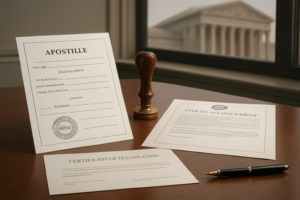
If you have searched for apostille notary near me, you are likely trying to legalize a U.S. document for use in another country. In practical terms, people often use this phrase when they need help with three connected services: notarization, apostille processing, and sometimes certified translation. While these services are related, they are not the same thing, and understanding the difference can save you time, money, and rejected paperwork.
An apostille is a certificate issued by a competent government authority that authenticates the origin of a public document for use in a country that is a member of the Hague Apostille Convention. A notary verifies identity, witnesses signatures, and notarizes certain documents. A certified translation provides an accurate translated version of a document, often with a signed certification from the translator or translation company.
When people look for an apostille notary near me, they are usually looking for a professional service that can guide them through the entire process from start to finish. That may include reviewing the document, arranging notarization if needed, submitting it to the proper state or federal authority for apostille, and preparing certified translations for international use.
When and Why You May Need an Apostille
You may need an apostille when a U.S.-issued document must be presented in a foreign country for legal, educational, business, immigration, or personal purposes. Foreign authorities often require proof that the signature, seal, or stamp on the document is authentic.
Common situations include:
- Dual citizenship or immigration matters
- Marriage abroad
- International adoptions
- Studying overseas
- Working in another country
- Opening a foreign bank account
- International business formation or contracts
- Power of attorney for use overseas
- Birth, marriage, divorce, or death records
- School transcripts, diplomas, and background checks
For example, if you are getting married in another country, the local government may ask for your birth certificate and single status affidavit with an apostille. If you are applying for a visa or residency permit, you may need apostilled FBI background checks, diplomas, or marriage certificates. If you are conducting business abroad, incorporation papers, certificates of good standing, or powers of attorney may need both notarization and apostille.
Apostille vs. Notarization: What Is the Difference?
This is one of the most common points of confusion for people searching for an apostille notary near me. A notarization is not the same as an apostille, and one does not automatically replace the other.
Notarization
A notary public verifies the identity of the signer, confirms willingness to sign, and completes a notarial certificate. Notarization is commonly required for affidavits, powers of attorney, consent letters, and copies of certain private documents.
Apostille
An apostille is issued after the document is properly prepared. For state-issued documents, the apostille is usually issued by the Secretary of State. For federal documents, it may be issued by the U.S. Department of State after prior authentication steps. The apostille confirms the authenticity of the official signature or seal on the document.
Why Both May Be Needed
Some documents, such as a birth certificate, are already official records and may not need notarization before apostille. Other documents, such as a power of attorney or affidavit, usually need to be notarized first before they can be apostilled. That is why working with a professional apostille service can be helpful: the required steps depend on the type of document and the destination country.
What Types of Documents Can Be Apostilled?
The exact eligibility depends on the issuing authority and destination country, but common documents include:
- Vital records: birth certificates, marriage certificates, death certificates, divorce decrees
- Personal documents: affidavits, powers of attorney, passport copies, consent letters
- Educational documents: diplomas, transcripts, enrollment letters, teaching credentials
- Business documents: articles of incorporation, bylaws, board resolutions, certificates of good standing, contracts
- Judicial and government records: court orders, criminal background checks, FBI background checks
Not every document can be apostilled in the same way. Some must be original certified copies issued by the proper government office. Others can be notarized copies or signed statements. The key is to confirm the destination country’s requirements and the issuing authority’s rules before filing.
Step-by-Step: How the Apostille Process Works
If you are looking for an apostille notary near me, here is the process you can generally expect.
- Identify the destination country.The first step is determining where the document will be used. If the destination country is a member of the Hague Apostille Convention, you typically need an apostille. If it is not, you may need a different legalization process through the embassy or consulate.
- Review the document type.Determine whether the document is a public record, a notarized private document, or a federal document. This affects where and how it must be authenticated.
- Obtain the correct original or certified copy.For vital records, many states require a recently issued certified copy from the vital records office. Photocopies are often rejected unless they are properly notarized and accepted for that category of document.
- Complete notarization if required.If the document is a private document, such as an affidavit or power of attorney, it will usually need notarization before apostille. The notary wording must also meet state requirements.
- Submit to the proper authority.State documents are usually submitted to the Secretary of State in the state where the document was issued or notarized. Federal documents, such as FBI background checks, may require federal authentication channels.
- Include fees and request forms.Each state has its own apostille request form, fee schedule, and submission rules. Missing forms, incorrect payment, or incomplete addresses can delay processing.
- Request certified translation if needed.If the receiving country requires the document in another language, you may also need a certified translation. In some cases, the translation itself may need notarization or apostille, depending on the foreign authority’s instructions.
- Verify final package before international use.Before sending the document abroad, confirm that names, dates, seals, and translations match exactly and that the apostille is attached to the correct document.
What Documents and Information Should You Prepare?
To make the process easier, gather the following before contacting an apostille service:
- The original document or a certified copy, if required
- The destination country
- The purpose of the document, such as marriage, visa, school, or business
- Any deadline you are working under
- A valid government-issued ID if notarization is needed
- Any special instructions from the foreign authority, employer, school, or consulate
- Translation requirements, including the target language
Having these details ready helps avoid the most common problem in apostille work: preparing the wrong version of the document.
How Certified Translation Fits Into the Process
Many international transactions require not only an apostille but also a certified translation. If the receiving authority does not accept English-language documents, a certified translation may be mandatory.
A certified translation is generally a complete and accurate translation accompanied by a signed statement certifying that the translation is true and correct to the best of the translator’s knowledge and ability. Requirements vary by country and institution. Some ask only for a certified translation; others may require notarization of the translator’s certification, and in certain cases, that notarized translation may also need apostille.
Examples of documents commonly translated include:
- Birth certificates
- Marriage certificates
- Academic transcripts and diplomas
- Powers of attorney
- Corporate documents
- Background checks
If you are searching for an apostille notary near me, choosing a provider that also offers certified translation can simplify the process and reduce the risk of inconsistencies between the original document and the translated version.
Typical Costs for Apostille, Notary, and Translation Services
Costs vary by state, document type, and turnaround time, but here is a general overview for U.S. clients:
- Notary fees: Often set by state law; typically modest per signature or notarized act
- State apostille fees: Usually charged per document by the Secretary of State
- Federal authentication fees: May apply to federal documents
- Service fees: Professional apostille agencies may charge handling, courier, or expedited processing fees
- Certified translation fees: Often based on per word, per page, or per document pricing
- Shipping fees: Overnight or international shipping may increase total cost
In many cases, the total cost depends less on the apostille itself and more on whether you need rush handling, retrieval of certified copies, notarization, and translation. For that reason, it is wise to request a clear quote in advance.
Typical Timelines: How Long Does It Take?
People searching for an apostille notary near me are often in a hurry. Processing times can range from very fast to several weeks depending on the authority and the complexity of the request.
- Notarization: Often completed the same day
- State apostille: May take from a few business days to several weeks
- Federal apostille or authentication: Often longer than state processing
- Certified translation: Frequently available within 1 to 3 business days, depending on length and language
- Rush service: May be available through professional agencies for urgent cases
Delays often happen because of incorrect notarization, wrong document versions, missing request forms, or mailing issues. A professional review before submission can help prevent these setbacks.
Common Mistakes to Avoid
Even a small error can cause rejection. Here are some of the most common mistakes people make when handling apostille requests on their own:
- Using the wrong document version, such as an uncertified birth certificate copy
- Assuming notarization alone is enough for international use
- Submitting to the wrong state or authority
- Failing to check whether the country accepts apostilles
- Using incomplete or incorrect notary wording
- Sending damaged, altered, or illegible documents
- Overlooking translation requirements
- Waiting until the last minute when international deadlines are strict
One of the biggest mistakes is assuming all documents follow the same rules. In reality, apostille requirements differ based on document type, issuing state, and destination country.
How to Choose the Right Apostille Service
When evaluating an apostille notary near me, look for a provider that offers more than just basic notarization. You want a service that understands document authentication, state and federal procedures, and translation requirements.
Look for these qualities:
- Experience with apostille services for personal, academic, and business documents
- Knowledge of state-specific and federal requirements
- Access to notary services when needed
- Availability of certified translation
- Clear pricing and turnaround estimates
- Responsive communication and document review support
A professional service can help you avoid rejected submissions, reduce delays, and ensure that your documents are properly prepared for use abroad.
Final Thoughts
Searching for an apostille notary near me usually means you need fast, accurate help with documents that will be used internationally. Whether you are handling a birth certificate, power of attorney, diploma, marriage record, or business filing, the right process matters. Apostille, notarization, and certified translation each serve a different purpose, and knowing when each one applies is essential.
For U.S. clients, the safest approach is to confirm the destination country’s requirements, gather the correct original or certified documents, complete notarization where necessary, and work with a trusted apostille professional who can manage the process efficiently. With the right support, you can avoid costly mistakes and move forward with confidence.
If you need guidance on document authentication, notarization, or certified translation, working with an experienced apostille service can make the process simpler, faster, and far less stressful.
