
Dual Citizenship Vital Record Authentication Guide
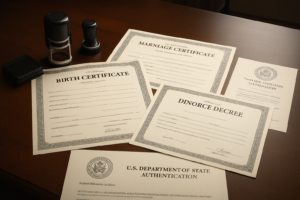
Dual citizenship vital record authentication is one of the most important steps for applicants who must present U.S. birth certificates, marriage certificates, or divorce decrees to a foreign government. If the destination country is not part of the Hague Apostille Convention, an apostille is not enough. Instead, your documents usually must go through a longer embassy legalization process so they can be accepted for citizenship, civil registry, passport, or consular filing purposes abroad.
For many dual citizenship applicants, the challenge is not obtaining the vital record itself. The real difficulty is understanding which certification path applies, how to avoid rejection, and when certified translation is required. This guide explains the full process, the documents commonly needed, timelines, costs, and the most common mistakes to avoid.
What Is Dual Citizenship Vital Record Authentication?
Dual citizenship vital record authentication is the process of validating civil documents for use in a foreign country that requires embassy or consulate legalization rather than an apostille. These records often include:
- Birth certificates to prove lineage, parentage, or place of birth
- Marriage certificates to document marital status or a family relationship
- Divorce decrees to prove termination of a prior marriage
- Death certificates in some nationality or inheritance-related cases
When a foreign authority requests “authentication” or “legalization,” it generally means the document must pass through a chain of U.S. and foreign certifications so the receiving country can trust that the signature and seal are genuine.
Embassy Legalization vs. Apostille: Why the Difference Matters
The difference between an apostille and embassy legalization is critical. An apostille is used when the receiving country is a member of the Hague Apostille Convention. It is typically issued by the Secretary of State for state documents or by the U.S. Department of State for certain federal documents.
By contrast, if the destination country is not a Hague Convention member, your records usually require embassy legalization. This is a multi-step process that may include state certification, federal authentication, and final legalization by the destination country’s embassy or consulate.
For dual citizenship cases, applicants often assume that any international document request means apostille. That mistake can cause delays, extra fees, and rejected filings. The foreign consulate’s instructions and the citizenship program’s current requirements should always be checked before submitting documents.
The Non-Hague Chain for Dual Citizenship Vital Record Authentication
Although exact requirements vary by country and by document type, the non-Hague legalization chain typically follows these steps:
- Obtain the correct original or certified copy
- Notarization or certified copy review, if required
- County or Secretary of State certification
- U.S. Department of State authentication
- Embassy or consulate legalization
1. Obtain the Correct Vital Record
For birth, marriage, and divorce records, the first step is securing the right version of the document. Most embassies require a recent certified copy issued by the proper state or county authority. Photocopies are usually not accepted unless they have been properly notarized and the receiving authority expressly allows them.
Some consulates also require long-form birth certificates rather than abstract versions. If the document is older, damaged, laminated, or missing a registrar’s signature or seal, it may be rejected during certification.
2. Notarization or Certified Copy Review
Vital records are usually government-issued certified documents, so they often do not need separate notarization. However, supporting documents in a dual citizenship file may require notarization, such as affidavits, sworn statements, passport copies, or explanatory letters.
In some cases, a certified translation or copy certification may also need notarization before the next stage. Because requirements differ by country, this step should be confirmed before moving forward.
3. County or Secretary of State Certification
For state-issued vital records, the next step is often certification by the Secretary of State in the state where the document originated. If a notarized document is involved, the county clerk may need to certify the notary before the Secretary of State can act.
This stage confirms the authenticity of the public official’s signature or the notary’s commission. Without this certification, the U.S. Department of State or foreign embassy may refuse to process the document.
4. U.S. Department of State Authentication
After state certification, documents for non-Hague countries generally move to the U.S. Department of State in Washington, D.C. This office authenticates the state official’s signature so the foreign embassy can rely on it.
This is the federal link in the legalization chain. It does not replace embassy legalization; it prepares the document for final foreign consular action.
5. Embassy or Consulate Legalization
The final step is legalization by the destination country’s embassy or consulate. This is where the foreign government formally recognizes the U.S. document for use in its legal system. Each embassy has its own rules on fees, forms, jurisdiction, appointments, prepaid return labels, and translation standards.
Some embassies legalize only after reviewing a complete application packet. Others require separate consular forms or proof of the purpose, such as a citizenship appointment confirmation.
Documents Commonly Needed for Dual Citizenship Cases
Most applicants should expect to prepare some combination of the following:
- Certified birth certificate
- Certified marriage certificate
- Certified divorce decree or judgment
- Valid passport copy
- Government-issued photo identification
- Application forms required by the embassy or consulate
- Certified translations
- Supporting affidavits or sworn statements
- Proof of relationship to the ancestor or family member
It is also common for consulates to request that records be recently issued, sometimes within the last six to twelve months. Even if an older certified copy is legally valid, a fresh copy may still be required for a citizenship file.
How Certified Translation Fits In
Many dual citizenship applications require records to be translated into the official language of the destination country. Certified translation is often needed for birth certificates, marriage certificates, divorce decrees, and supporting affidavits.
The timing of translation matters. In many cases, the document should be fully legalized first, then translated if the consulate wants the translation to reflect the final seals and certificates. In other cases, the consulate may require translation before final submission but not before each authentication stage.
Translation errors can create serious delays. Names, dates, places of birth, and marital status must match exactly across all records. Even minor inconsistencies can trigger requests for clarification or amended records.
Typical Timelines and Costs
Processing times vary based on the issuing state, federal workload, and the embassy’s procedures. A typical non-Hague legalization case may take anywhere from several weeks to a few months.
Factors affecting timeline include:
- How quickly certified records can be obtained
- Whether county certification is needed
- Secretary of State turnaround time
- U.S. Department of State processing backlog
- Embassy appointment availability or mail-in delays
- Translation turnaround time
Costs also vary, but applicants should plan for:
- Vital record issuance fees
- Notary fees, if applicable
- State certification fees
- Federal authentication fees
- Embassy legalization fees
- Certified translation fees
- Courier or shipping charges
Because embassy requirements can change without much notice, working with a professional legalization service can reduce avoidable repeat costs.
Common Mistakes That Cause Rejection
Dual citizenship files are often delayed by preventable issues. The most common include:
- Using an apostille when embassy legalization is required
- Submitting the wrong version of a birth or marriage certificate
- Sending a photocopy instead of a certified copy
- Missing a county clerk step for notarized documents
- Requesting translation too early or in the wrong format
- Name or date discrepancies across records
- Using records that are too old for consular acceptance
- Ignoring embassy-specific forms, fees, or return shipping rules
One small mismatch can affect an entire citizenship application. For example, if a parent’s name appears differently on a birth certificate and marriage certificate, the consulate may ask for an amendment, affidavit, or court order before proceeding.
Example Scenario: Preparing Records for a Non-Hague Country
Imagine a U.S. applicant seeking dual citizenship through a parent for a country that requires embassy legalization, not an apostille. The consulate asks for the applicant’s birth certificate, the parents’ marriage certificate, and the mother’s divorce decree from a prior marriage.
The applicant orders new certified copies from California and New York. The birth and marriage records are sent for state certification in their issuing states. The divorce decree, because it is a court document, is first reviewed to confirm the proper certified court seal is present. Once each document has the required state-level certification, all three are submitted to the U.S. Department of State for federal authentication.
After federal authentication, the packet goes to the foreign embassy for final legalization. The applicant then obtains certified translations into the destination country’s language based on the embassy’s submission rules. Because the names on the marriage certificate and divorce decree differ slightly, a supporting affidavit is also prepared and notarized, then legalized through the same chain. By handling each step in the correct order, the applicant avoids a rejected citizenship appointment.
Why Professional Help Can Save Time
Embassy legalization for dual citizenship is detail-heavy, document-specific, and time-sensitive. Different states issue records differently. Different embassies apply different standards. And a single missing certification can send the entire packet back to the beginning.
A professional service can help confirm the correct document type, manage the certification chain, coordinate U.S. Department of State authentication, and arrange certified translation where needed. This is especially valuable when applicants are working under consular appointment deadlines or dealing with records from multiple states.
If you need fast, accurate help with dual citizenship vital record authentication, la-apostille.com can assist with apostille alternatives, embassy legalization, notary support, and certified translation for your citizenship documents. Contact la-apostille.com to get your records prepared correctly the first time.
