
How to Inherit Property in a Foreign Country: A Practical Guide for U.S. Heirs
How to Inherit Property in a Foreign Country
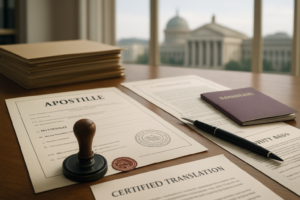
For many U.S. families, international inheritance issues arise unexpectedly. A parent retires abroad, a relative owns land in their country of origin, or a family home remains overseas for generations. When that owner passes away, heirs often need to figure out how to inherit property in a foreign country while navigating unfamiliar legal systems, document requirements, and strict procedural deadlines.
In most cases, inheriting foreign real estate is not as simple as presenting a will. You may need to prove your identity and relationship to the deceased, authenticate U.S. documents for use abroad, obtain certified translations, and comply with local probate, tax, and land registration rules. That is why understanding the process early is essential.
This guide explains how to inherit property in a foreign country from a U.S. perspective, including when the process is needed, the typical steps involved, what documents are required, and how apostille, notarization, and certified translation services can help move the matter forward efficiently.
What It Means to Inherit Property Abroad
Inheriting property abroad means acquiring ownership rights in real estate located outside the United States after the death of the owner. The property may be a home, apartment, parcel of land, commercial unit, or inherited family estate. Even if the deceased was a U.S. citizen, the law of the country where the property is located often plays a major role in determining how the transfer happens.
Foreign inheritance cases can involve several legal layers at once:
- The deceased person’s will or estate plan
- Local inheritance and probate laws in the foreign country
- Rules on forced heirship, marital rights, or reserved shares
- Tax obligations in the foreign country and potentially in the U.S.
- Document authentication requirements for cross-border use
Because of this, learning how to inherit property in a foreign country is usually both a legal and administrative process, not just a family matter.
When and Why the Process Is Needed
You may need to complete a formal foreign inheritance process whenever property is titled solely in the deceased person’s name and cannot legally pass to heirs without court approval, notarial action, or land registry updates. This often happens in civil law countries, where succession procedures are highly document-driven.
Common situations include:
- A U.S. resident inherits a parent’s house in Mexico, Spain, Italy, France, or another country
- A dual citizen dies owning real estate overseas
- A family member leaves land in their home country to children now living in the United States
- There is no will, and heirs must prove inheritance rights under local intestacy laws
- The foreign land registry requires apostilled and translated U.S. documents before transfer
The process is needed not only to establish legal ownership, but also to sell the property, occupy it, rent it, refinance it, or pay taxes associated with it. Without proper transfer, heirs may face title problems, frozen assets, or disputes with relatives and authorities.
Step-by-Step: How to Inherit Property in a Foreign Country
1. Confirm Where the Property Is Located and Which Law Applies
The first step in understanding how to inherit property in a foreign country is identifying the exact jurisdiction where the property is located. Real estate is generally governed by the law of the country where it sits, not by the law of the heir’s residence. Even when a U.S. will exists, a foreign court, notary, or registry may still require a local succession procedure.
Start by gathering:
- The exact property address
- A copy of the deed or title record, if available
- The deceased owner’s full legal name
- The country, province, or municipality with authority over the property
2. Determine Whether There Is a Will
If the deceased left a will, that document may guide who inherits the property. However, a foreign country may require the will to be reviewed, probated, or recognized locally before it can be enforced. In some countries, forced heirship rules override certain will provisions.
If there is no will, local intestacy laws usually determine who inherits and in what shares. This can affect spouses, children, parents, and even extended relatives.
3. Open the Appropriate Probate or Succession Process
Depending on the country, inheritance may proceed through a probate court, civil court, notary, or administrative land office. Some jurisdictions require a formal declaration of heirs. Others require a grant of probate, letters testamentary, or equivalent foreign recognition of a U.S. estate proceeding.
This is often where U.S. heirs discover they need multiple official documents prepared for international use.
4. Collect the Required Documents
One of the most important parts of how to inherit property in a foreign country is assembling a complete and properly authenticated document package. While requirements vary by country, the following documents are commonly requested:
- Death certificate of the deceased
- Will and any codicils
- Probate court orders or letters testamentary, if issued in the U.S.
- Affidavit of heirship or declaration of heirs
- Birth certificates of heirs
- Marriage certificate, if a spouse is involved
- Passports or government-issued identification
- Property deed, title extract, or land registry certificate
- Tax identification numbers or foreign tax forms
- Power of attorney, if someone will act on your behalf abroad
Many foreign authorities will not accept these documents unless they are notarized, apostilled, and translated correctly.
5. Obtain Notarization Where Required
Notarization is often needed when signing affidavits, powers of attorney, sworn statements, or certified copies for use in another country. A notary public verifies identity, witnesses signatures, and helps create a document that foreign authorities may accept as formally executed.
For example, if you cannot travel overseas, you may sign a power of attorney in the U.S. authorizing a lawyer, notary, or family member abroad to represent you in the inheritance process. That power of attorney usually must be notarized before further authentication.
6. Get an Apostille or Authentication
Apostille is one of the most common requirements in international inheritance matters. An apostille certifies the origin of a public document so it can be recognized in another country that is a member of the Hague Apostille Convention.
Typical inheritance-related documents that may need an apostille include:
- Death certificates
- Birth and marriage certificates
- Court-issued probate documents
- Notarized powers of attorney
- Affidavits and sworn statements
If the foreign country is not part of the Hague Convention, a different legalization process may apply, often involving state certification, U.S. Department of State authentication, and consular legalization.
For U.S. heirs, this step is critical. A document that is valid in the United States may be rejected abroad unless it has the proper apostille or authentication attached.
7. Obtain Certified Translation
Most foreign authorities require documents in the official language of their jurisdiction. That means English-language death certificates, court orders, affidavits, and powers of attorney often need certified translation.
Certified translation is not just a basic language conversion. It is a formal translation accompanied by a signed certification attesting that the translation is complete and accurate. In some countries, additional requirements may apply, such as sworn translation, translator registration, or local formatting standards.
When dealing with inheritance, accuracy matters. A mismatch in names, dates, legal terminology, or property descriptions can delay the case significantly.
8. Submit the File to the Foreign Authority
Once the documents are ready, they are submitted to the appropriate foreign court, notary, land registry, or tax office. Additional local forms, filing fees, and tax declarations may be required. If multiple heirs are involved, each heir may need to provide separate documentation.
At this stage, the authority may review:
- Whether the heirs are legally entitled to inherit
- Whether inheritance tax is due
- Whether the property is free of liens or disputes
- Whether the title can be transferred immediately or only after additional approvals
9. Register the Transfer of Ownership
After the succession is approved, the final step is registering the heirs as the new owners in the foreign land records. Until this registration is complete, heirs may not have full legal control over the property.
Once recorded, the heirs can generally decide whether to keep, occupy, lease, or sell the property, subject to local law.
How Apostille, Notarization, and Certified Translation Apply
For cross-border inheritance matters, these three services often work together:
- Notarization helps validate signatures on powers of attorney, affidavits, and declarations.
- Apostille confirms the authenticity of U.S. public documents and notarized documents for use abroad.
- Certified translation makes the documents understandable and acceptable to foreign authorities.
For example, if you are learning how to inherit property in a foreign country and need to authorize a lawyer overseas, you may need to sign a power of attorney before a U.S. notary, obtain an apostille for that notarized document, and then have it translated into the foreign language. Missing any one of those steps can cause rejection.
Typical Costs and Timelines
Costs vary widely depending on the country, the number of heirs, the value of the property, and whether there is a dispute. Still, U.S. heirs can expect several categories of expense:
- Certified copies of vital records
- Notary fees
- Apostille or authentication fees
- Certified translation fees
- Foreign lawyer or notary fees
- Court filing and registry fees
- Inheritance or transfer taxes, if applicable
As a general estimate:
- Basic document preparation may take a few days to two weeks
- Apostille processing may take several days to several weeks, depending on the state
- Certified translation may take one to five business days for standard files
- Foreign probate or succession can take a few months to more than a year
Simple, uncontested cases move faster. Cases involving missing documents, multiple heirs, tax issues, or unclear title usually take longer.
Common Mistakes to Avoid
When dealing with how to inherit property in a foreign country, avoid these common errors:
- Assuming a U.S. will is automatically valid abroad. Many countries require local recognition or separate succession procedures.
- Sending documents without apostille. Foreign authorities often reject unauthenticated U.S. documents.
- Using non-certified translations. Informal or machine translations may not be accepted.
- Overlooking name inconsistencies. Differences in spelling, middle names, or married names can cause delays.
- Waiting too long. Some countries impose filing deadlines, tax deadlines, or penalties for delay.
- Ignoring tax consequences. Inheritance tax, capital gains, and reporting obligations may apply.
- Failing to use a properly drafted power of attorney. If you cannot appear in person, the document must meet local legal standards.
Practical Tips for U.S. Heirs
If you are trying to determine how to inherit property in a foreign country, take a proactive approach:
- Identify the foreign authority handling the property transfer.
- Request a written list of required documents.
- Order certified copies of U.S. vital records early.
- Confirm whether the destination country accepts apostilles or requires consular legalization.
- Use professional notarization, apostille, and certified translation services to avoid rejection.
- Keep digital and paper copies of every submission.
- Consult local counsel in the foreign country for property, probate, and tax advice.
Conclusion
Understanding how to inherit property in a foreign country is essential for any U.S. heir dealing with overseas real estate. The process usually involves more than proving family relationship. You may need probate or succession filings, notarized powers of attorney, apostilled U.S. documents, and certified translations before a foreign court, notary, or land registry will transfer title.
Because each country has its own inheritance rules, document standards, and tax procedures, accuracy matters at every step. Proper preparation can reduce delays, prevent costly rejections, and help you secure your legal rights to the property.
For international inheritance matters, professional support with apostille, notarization, and certified translation can make the process smoother and more reliable. When documents must cross borders, they should be prepared correctly the first time.
