
All you need to know about Apostille
The Essential Guide to Apostille Services: Navigating International Document Authentication
In an increasingly globalized world, cross-border legal, professional, and personal transactions have become a standard part of life. Whether you are moving abroad, purchasing property in another country, establishing a business overseas, or managing an international inheritance, you will quickly encounter a critical administrative hurdle: ensuring your domestic documents are recognized as legally valid by a foreign government.
If you are a U.S. citizen or resident dealing with foreign authorities, the standard domestic notarization or state seal is rarely enough. Instead, you will almost certainly be asked to provide an Apostille.
Navigating the world of international document authentication can feel overwhelming, packed with dense legal jargon and strict bureaucratic procedures. This comprehensive guide breaks down exactly what an apostille is, when you need it (with a specific look at U.S.-to-Mexico transactions), and how you can seamlessly obtain one using professional services in Southern California.
What is an Apostille? Understanding the Basics
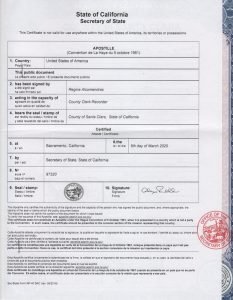
At its core, an apostille (pronounced “ah-po-steel”) is a specialized certificate issued by a designated government authority that authenticates the origin of a public document.
The concept was born out of the Hague Convention of October 5, 1961, formally known as the Apostille Convention. Before this treaty, validating a document for international use was a grueling, multi-layered nightmare known as “legalization.” It required a document to be certified by local officials, then state officials, then the national government, and finally by the embassy or consulate of the destination country.
The Hague Convention drastically simplified this process for its member nations. Under the treaty, participating countries agreed to bypass the multi-step embassy legalization chain. Instead, a single certificate—the apostille—attached by the originating country’s designated authority is all that is required to certify that:
-
The signature on the document is genuine.
-
The capacity in which the person signing the document acted is legitimate.
-
The identity of any seal or stamp on the document is verified.
Important Distinction: An apostille does not validate or certify the actual content of the document. It simply proves to a foreign official that the document itself is authentic, official, and legally binding in its country of origin.
When Do You Need an Apostille?
You will generally need an apostille if you meet two specific conditions:
-
The country where the document was issued and the country where it will be used are both members of the Hague Apostille Convention.
-
The foreign entity (a school, court, bank, or government agency) explicitly requests it to process your paperwork.
The types of documents that commonly require an apostille fall into three main categories:
1. Vital Statistics and Civil Documents
These are state-issued documents certifying major life events, including birth certificates, marriage certificates, death certificates, and divorce decrees. Foreign governments require apostilles on these to verify identity, lineage, and marital status for visas, citizenship applications, or legal marriages abroad.
2. Legal and Personal Documents
This category includes Powers of Attorney (POA), wills, affidavits, and corporate documents (like Articles of Incorporation or bylaws). For example, if you cannot travel overseas to sign a deed or manage an estate, a foreign bank or notary will require an apostilled Power of Attorney to let an agent act on your behalf.
3. Educational Documents
If you are planning to study or work abroad, foreign universities and employers will usually demand apostilled copies of your diplomas, transcripts, and school enrollments to verify your qualifications.
Real-World Case Study: Utilizing U.S. Documents in Mexico
To understand how this functions in daily life, let us examine one of the most common international document pipelines: the United States and Mexico.
Mexico is a proud member of the Hague Apostille Convention. Therefore, any official document generated in the U.S. must carry an apostille before it can be legally recognized by Mexican authorities, banks, or courts. If you attempt to present a standard U.S. document in Mexico without this stamp, it will be rejected outright.
Consider these three incredibly common scenarios where an apostille is mandatory for Mexico:
U.S. Birth Certificates
If a child is born in the United States to Mexican parents, the parents often wish to register the child for dual Mexican citizenship. To do this at a Mexican consulate or registry office (Registro Civil), the American birth certificate must be apostilled by the state in which the birth occurred. The same rule applies to adults moving to Mexico on permanent residency visas.
Marriage Certificates
Are you moving to Mexico with your spouse, buying property together, or applying for dependency visas? Mexico will require your U.S. marriage certificate to be officially apostilled. This proves to the Mexican immigration or tax authorities that your legal union is recognized under international standards.
Power of Attorney (Poder Notarial)
This is perhaps the most critical document for cross-border real estate and estate planning. Suppose you reside in California but inherit property in Guadalajara, or you are purchasing a beachfront condo in Cabo San Lucas. If you cannot be physically present in Mexico to sign the final contracts before a Mexican notary (Notario Público), you must draft a Power of Attorney in the U.S.
Because Mexico utilizes a Civil Law system, the Power of Attorney must be highly specific, often written in a bilingual format. Once you sign it before an American notary public, it must be apostilled. Without that apostille, your chosen representative in Mexico cannot sign a single document or touch a bank account on your behalf.
The Challenges of Going Solo: Why DIY Apostilles Cause Delays
On paper, getting an apostille sounds straightforward: you find the right government office, pay a fee, and get your stamp. In reality, the “Do-It-Yourself” route is riddled with administrative traps that frequently lead to rejected applications and missed deadlines.
Some of the hurdles include:
-
Jurisdictional Confusion: Federal documents (like FBI background checks) require an apostille from the U.S. Department of State in Washington, D.C. State documents (like birth certificates) must go to the Secretary of State from that specific state. County documents often require an extra layer of county clerk authentication before the state will touch them.
-
Notary Errors: If a local notary fails to use the exact legal wording required by their state, or if their commission has expired, the Secretary of State will reject the apostille request entirely.
-
Strict Timelines: Many international processes—especially inheritance or property purchases—are tied to strict statutory deadlines. Waiting weeks for a mailed-in application to clear a state office only to find out it was rejected can cause a massive domino effect of legal headaches.
The Smooth Alternative: LA Apostille Services
For residents and businesses in Southern California, you do not have to brave the bureaucratic maze alone. You can conveniently streamline the entire process through LA Apostille Services, a trusted agency specializing in swift, accurate, and professional document authentication.
Whether you need to apostille a California birth certificate, a local corporate document, or a complex bilingual Power of Attorney for Mexico, utilizing a dedicated service guarantees that your paperwork is reviewed by experts before submission, completely eliminating the risk of costly rejections.
Location and Accessibility
Convenience is key when handling time-sensitive legal matters. LA Apostille Services is centrally located in the heart of Los Angeles at:
2975 Wilshire Blvd #5
Los Angeles, CA 90010
Situated along the vibrant Wilshire corridor, the office is easily accessible from various parts of the city, making it simple to drop off your critical physical documents or pick up your finalized, authenticated packages.
Stress-Free Parking
Anyone familiar with driving in Los Angeles knows that parking can turn a quick errand into an absolute nightmare. LA Apostille Services eliminates this urban headache by offering highly accessible parking options for visitors:
-
Street Parking: Ample metered and timed street parking is available along Wilshire Boulevard and the surrounding cross streets for quick drop-offs.
-
Adjacent Parking Lot: If you prefer a quick, guaranteed spot without driving around the block, you can utilize the highly convenient, dedicated parking lot directly adjacent to the building. This makes visiting the office incredibly efficient, allowing you to walk right in and get your documents handled without stress.
Conclusion: Protect Your International Ventures
Securing an apostille is the vital bridge that transforms a localized American document into a globally recognized legal asset. Whether you are validating a birth certificate for dual citizenship, securing a marriage license for a foreign move, or empowering an attorney-in-fact to manage an estate in Mexico, doing it right the first time is paramount.
By entrusting your documentation to a specialized provider like LA Apostille Services, you bypass the long government queues, protect your timeline from bureaucratic errors, and gain peace of mind knowing your international affairs are anchored on legally flawless paperwork. The next time your international plans require document authentication, skip the confusion, head over to Wilshire Blvd, park with ease, and let the specialists handle the rest.
