
Foreign Birth Certificate Legalization for Inheritance
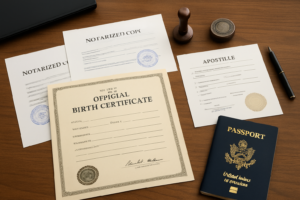
Foreign birth certificate legalization for inheritance is often required when you must prove family relationship to claim property, land, bank funds, or other estate assets in another country. If an overseas probate court, land registry, bank, or notary asks for your birth certificate, they usually will not accept a plain U.S. document. Instead, they may require an apostille or a full embassy legalization chain, and sometimes a certified translation as well. Understanding which process applies can save weeks of delay when inheritance deadlines are already stressful.
When someone passes away abroad, heirs are commonly asked to show evidence of identity and lineage. A birth certificate may be used to prove that you are the child, sibling, or grandchild of the deceased. In civil-law countries especially, inheritance procedures are document-heavy, and a missing authentication can stop the transfer of title or release of funds. That is why preparing the document correctly from the start matters.
Why foreign birth certificate legalization for inheritance is required
Foreign authorities need confidence that a U.S. birth certificate is genuine before they rely on it in a legal proceeding. Authentication bridges that trust gap. The exact requirement depends on the country where the inheritance matter is being handled:
- Apostille: Used when the destination country is a member of the Hague Apostille Convention.
- Embassy or consular legalization: Used when the destination country is not part of the Hague Convention or when the receiving authority specifically requires consular legalization.
In inheritance cases, the receiving office may be a probate court, civil registry, property office, tax office, bank, or local notary. Each may use slightly different language, but the goal is the same: verify the origin of the document so it can be accepted abroad.
Apostille vs. embassy legalization: what is the difference?
Many families hear the word “apostille” and assume it applies everywhere. It does not. The right process depends on the destination country.
When an apostille is enough
If the country handling the inheritance is a Hague Convention member, the birth certificate usually needs an apostille from the appropriate U.S. authority. For state-issued birth certificates, that is commonly the Secretary of State in the state where the certificate was issued.
An apostille is a standardized certificate recognized among Hague member countries. It simplifies international document use because it replaces the longer embassy legalization chain.
When embassy legalization is required
If the destination country is not a Hague member, you generally need the full legalization process. For a birth certificate, this often includes:
- Obtain a certified copy of the birth certificate from the proper vital records office.
- State-level certification from the Secretary of State where the document was issued, if required for that document type and destination.
- U.S. Department of State authentication in Washington, D.C.
- Embassy or consulate legalization by the destination country’s embassy or consulate.
Some countries also require supporting documents, application forms, or proof of the inheritance matter before the embassy will legalize the record.
The non-Hague chain for inheritance documents
For non-Hague destinations, the legalization chain must usually be completed in the correct order. Skipping a step can lead to rejection.
1. Certified copy or proper original
Most foreign authorities want a recently issued certified copy of the birth certificate, not a photocopy. Short-form certificates may be rejected if the receiving authority wants full parentage details. In inheritance cases, long-form certificates are often preferred because they clearly show family relationships.
2. Notarization, if applicable
Vital records themselves are generally not notarized in the same way as private documents, but related items may be. For example, if you are also submitting an affidavit, passport copy, or power of attorney for the inheritance file, those may need notarization before they can move through the legalization chain.
3. County or Secretary of State certification
Depending on the document and state rules, the next step may be county clerk certification or direct certification from the Secretary of State. Birth certificates usually go to the Secretary of State in the issuing state, but procedures vary.
4. U.S. Department of State authentication
After state certification, the document is sent to the U.S. Department of State for federal authentication. This confirms the authority of the state official who signed the certification.
5. Embassy or consulate legalization
Finally, the destination country’s embassy or consulate legalizes the authenticated document. This final step allows the birth certificate to be presented in that country’s inheritance proceeding.
Because each embassy has its own fees, forms, mailing rules, and processing times, professional handling can prevent expensive errors.
Documents commonly required for an inheritance claim abroad
Although requirements vary by country and estate, heirs are often asked for more than just a birth certificate. A complete file may include:
- Certified birth certificate
- Death certificate of the deceased
- Marriage certificate, if surname changes must be explained
- Passport copy or government ID
- Affidavit of heirship or sworn statement
- Power of attorney for a lawyer or representative abroad
- Probate court forms or notarial declarations
- Certified translation of all required documents
If your name differs from the one on the birth certificate, additional documents may be needed to connect the records clearly.
How certified translation fits into the process
Many inheritance authorities abroad require the birth certificate and related documents to be translated into the official language of the destination country. A simple bilingual friend translation is often not acceptable. Instead, you may need a certified translation, and in some cases the translation itself must also be notarized or legalized.
Timing matters. Some countries want the translation completed after apostille or legalization so the translator can include the authentication page. Others accept translation of the underlying document only. Checking the destination requirement before ordering translation helps avoid duplicate work.
Professional certified translation is especially important in inheritance matters because names, dates, places of birth, and parentage must match exactly across all records. Even a small inconsistency can trigger questions from a court or notary.
Typical timelines and costs
Processing times depend on the state of issuance, the federal workload, and the embassy involved. In general:
- Certified vital record issuance: a few days to several weeks
- Secretary of State processing: often a few business days to a few weeks
- U.S. Department of State authentication: can range from several weeks depending on volume
- Embassy legalization: from a few business days to multiple weeks
- Certified translation: often 1 to 3 business days, depending on length and language
Costs also vary. You may pay separate fees for certified copies, notarization where applicable, state certification, federal authentication, embassy legalization, shipping, and translation. Some embassies charge per document, while others charge per authentication. If your inheritance deadline is approaching, rush options may be available for certain steps, though not always for every authority.
Common mistakes that delay inheritance cases
- Using the wrong process: requesting an apostille when the country actually requires embassy legalization
- Submitting an uncertified copy: many authorities reject plain photocopies
- Ordering the wrong birth certificate format: short-form records may not prove lineage sufficiently
- Ignoring translation requirements: untranslated documents may be refused outright
- Name mismatches: failing to include marriage certificates or supporting records for surname changes
- Wrong sequencing: translating or notarizing at the wrong stage of the chain
- Outdated documents: some foreign offices require recently issued certificates
These problems are common when families try to handle a cross-border inheritance under time pressure. A document rejected by an embassy or probate office can delay the release of inherited assets for weeks or months.
Example: claiming inherited property in a non-Hague country
Imagine Maria, a U.S. resident, learns that her late father owned land in a non-Hague country. The local notary handling the estate asks Maria for a legalized birth certificate to prove she is the deceased’s daughter. Maria first orders a new long-form certified copy of her birth certificate from the state vital records office. Because the destination is not a Hague member, an apostille is not enough.
Her document then goes through state certification, U.S. Department of State authentication, and legalization at the destination country’s embassy. The notary abroad also requires a certified translation into the local language. Maria’s current surname differs from the one on her birth certificate, so she adds her marriage certificate to connect the records. Once the legalized and translated documents are accepted, the inheritance file can move forward and the land transfer can be recorded.
This is a realistic example of why the correct process matters. One missing certificate or one wrong authentication step could have delayed the estate settlement significantly.
How to prepare your birth certificate correctly the first time
- Confirm the destination country and whether it accepts apostilles or requires embassy legalization.
- Ask the receiving authority what version of the birth certificate is required.
- Order a recent certified copy from the proper issuing office.
- Determine whether related documents also need notarization, authentication, or translation.
- Complete the chain in the correct order.
- Use a professional service if deadlines, embassy rules, or multiple documents are involved.
Inheritance matters are already emotionally difficult. The document process should not add unnecessary uncertainty. With proper planning, your birth certificate can be authenticated in a form that foreign authorities will accept.
If you need help with apostille, embassy legalization, notary support, or certified translation for an inheritance case, la-apostille.com can guide you through the process and help you avoid costly delays. Contact us to get your documents prepared correctly for use abroad.
